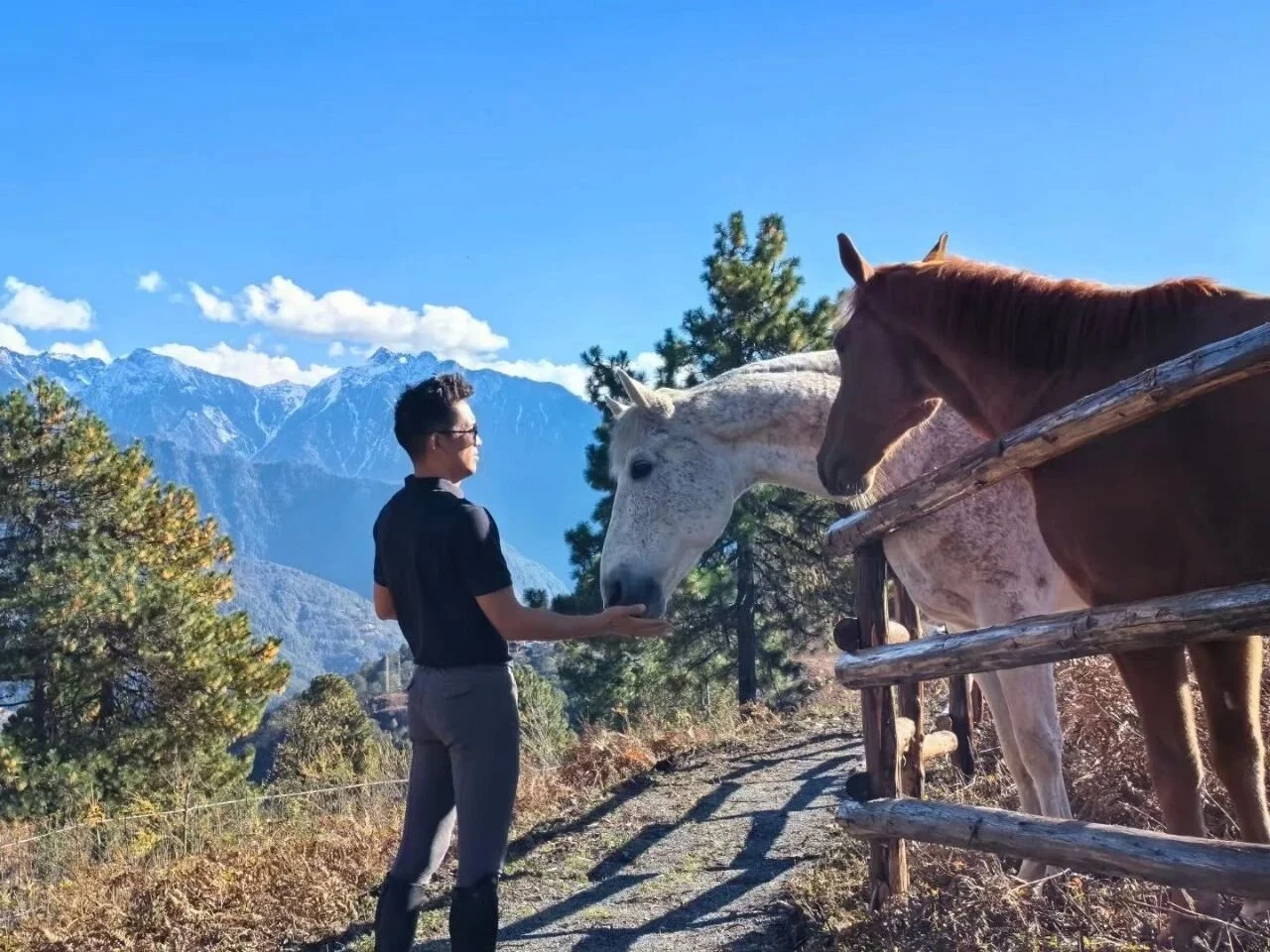
Director Xing shares a quiet moment with two of his horses—a reminder that the deepest connections are formed not through riding, but through simply being together.
Before there was a ranch, before there were 2,000 acres of grassland, before there was a place called Miracle Ranch, there was a boy who watched a show jumping competition on television and thought: That's what I want to do.
That boy would grow up to become a coach, a trainer, a competitor. He would earn certifications from the CHS, the FEI, and the British Horse Society. He would train horses in Beijing, Shanghai, Inner Mongolia, and Yunnan. He would build a career that, by any measure, was successful.
But inside, something was missing.
This is the story of Director Xing—the man behind Miracle Ranch. It is a story about horses, yes. But more than that, it is a story about salvation.
Horses and humans, saving each other. One miracle at a time.
A Childhood Dream
Director Xing was not born into the equestrian world.
He studied art and graphic design. He grew up in the city. His path to horses was not a straight line, but rather a detour, a discovery, a calling.
"I was about eight or nine years old when I watched a European Championship show jumping competition," he recalls. "At that moment, I thought: That's so cool. I want to do this."
What drew him was not the competition itself, but something deeper: the trust between horse and rider. The partnership. The way two beings could move together, as one, over obstacles that seemed impossible.
"I was especially drawn to that deep trust between horse and rider," he says. "Completing one obstacle after another. But to become that kind of rider, to reach that top level of competition, I know it requires a lot of resources and energy."
He pursued this dream. He trained. He competed. He became a coach, then a trainer. He worked with horses in some of the most prestigious equestrian clubs in China. He earned respect, certifications, and accolades.
But the path was not always smooth. And eventually, he faced the biggest challenge of all.
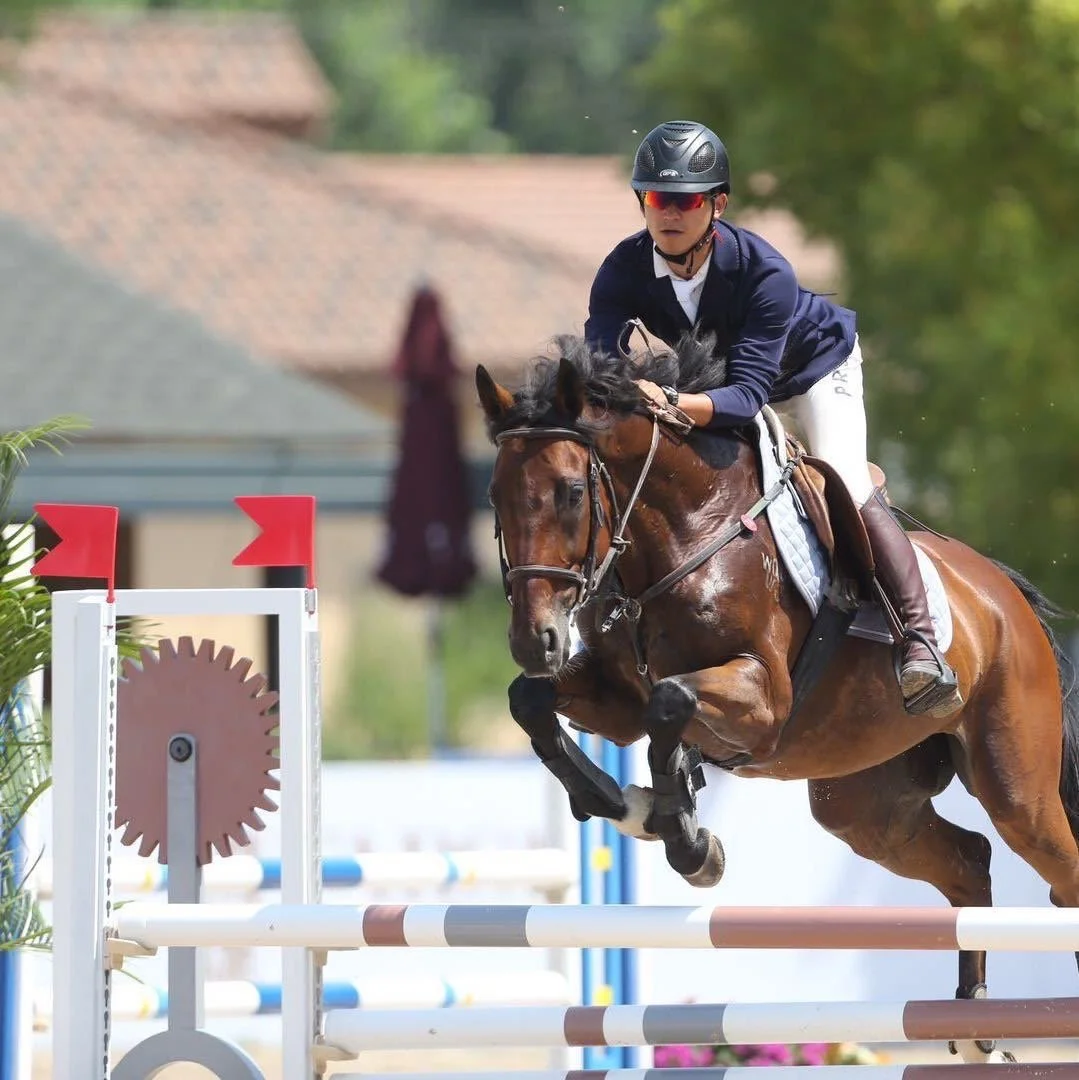
A younger Director Xing, mid-flight over a show jumping obstacle. Years before Miracle Ranch, he was already learning the lessons that would shape his life: trust, communication, and the courage to leap.
The Turning Point
A few years ago, his own horse, DaXiong, was injured.
"When I discovered that my horse was injured and I could no longer compete, I thought: What else can I do that's more meaningful?"
It was a question that changed everything.
During his years as a coach, Director Xing had observed something that troubled him. Many horses, he realized, were not happy. They were subjected to repetitive lessons, circling and running endlessly. They were confined to stables. They were treated as tools, not as beings.
"I sensed that some horses weren't really willing to take lessons," he says. "Or that they were actually suffering."
The more he thought about it, the more he felt called to do something different. Something that would give back to the horses that had given him so much.
"I thought: How can I make things a little easier for horses? Because horses have given me so much."
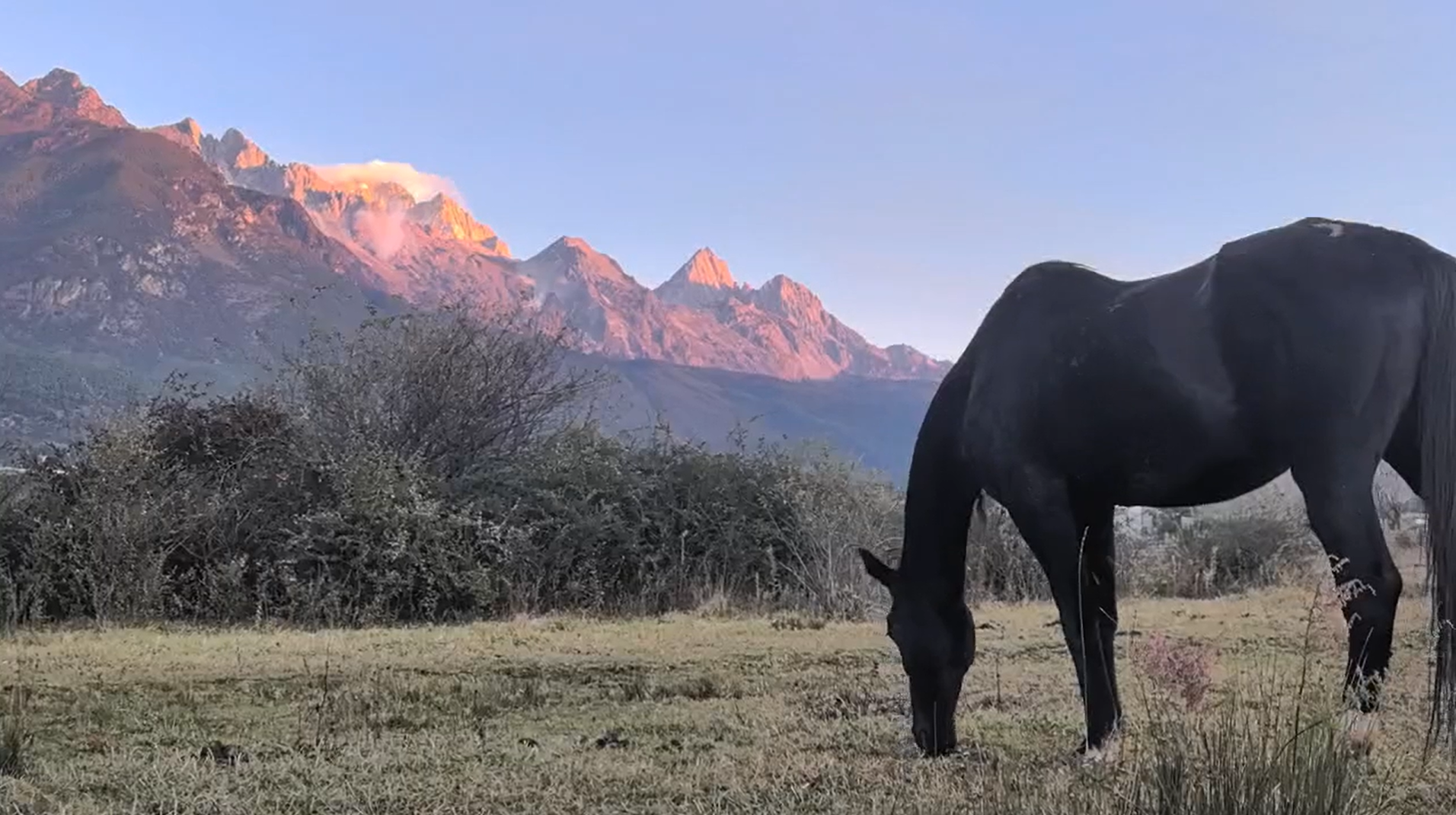
Daxiong. The horse that started it all. Here he grazes peacefully at sunset, beneath the watchful gaze of Yulong Snow Mountain—a place where a miracle unfolded, one slow day at a time.
A Void Filled by Horses
To understand why Director Xing felt such a debt to horses, you have to understand his backstory and the void that horses filled.
"I'm a post-80s generation," he says. "In my parents' generation, it was very difficult to express love, to have physical touch or express affection. These were things I experienced very little of while growing up."
He pauses. Then he says something that shifts the entire conversation.
"If there's no love in your heart, it's very difficult to give love to others."
For Director Xing, horses became the source of the love he had never received. They did not judge him, did not demand anything from him. They simply accepted him. And in that acceptance, he found something he had been searching for his entire life.
"In this process, I definitely feel that I have grown." He does not say this with pride. He says it with humility—with the awareness that he is still learning, still growing, still discovering what it means to love and be loved.
We asked him whether he had ever thought about giving up in his over 20 years of working with horses.
"Never. Not once," he replies. "Because throughout my career, through my connection with horses, I integrated into the herd. This process has benefited my life, my own journey."
"Horses gave me a lot," he says. "They filled that void. They gave me trust. They gave me belonging. They gave me the strength to keep living."
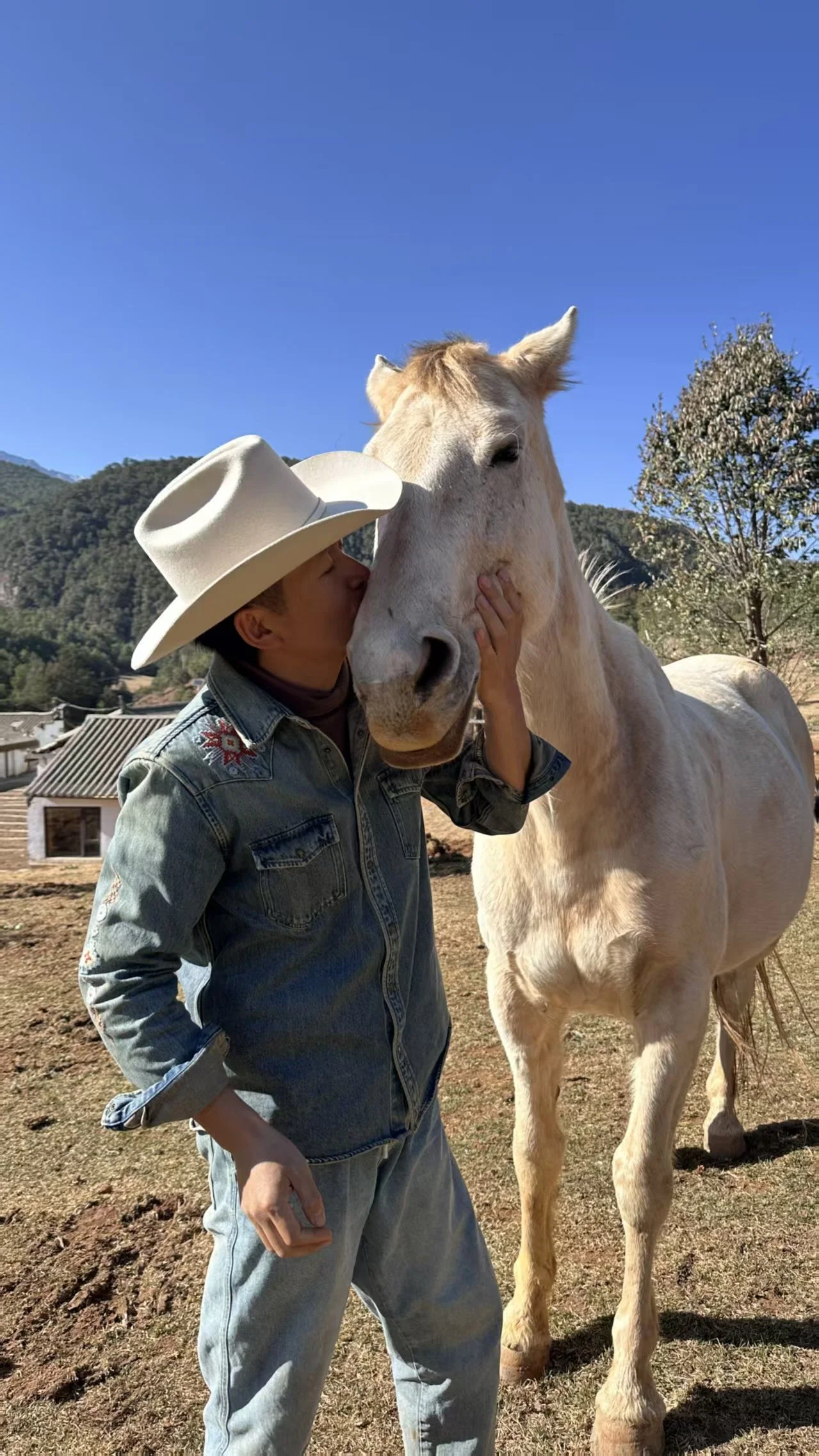
A moment of pure, unguarded love. Director Xing kisses one of the retired horses at Miracle Ranch—a simple gesture that says everything words cannot.
The 3L Principle: A Philosophy of Connection
From competitor to coach to trainer to founder of Miracle Ranch, this process of transformation had allowed Director Xing to develop a framework for understanding the human-horse relationship. He calls it the 3L Principle: Love, Language, Leadership.
Love is the foundation. "Many people see a horse and think: it's so big, so powerful—and they feel afraid," he explains. "So in their so-called 'training,' they want the horse to be afraid of them. But if you truly want to train a horse, you need to build mutual trust. You need to let the horse feel your love."
Language is the bridge. Horses do not speak our language, but they communicate constantly—through body posture, ear position, breathing, and movement. "We need to understand equine behavioral psychology," he says. "We need to learn to speak 'horse.'"
Leadership is the goal. But leadership is not domination. It is not force. It is the kind of leadership that a lead horse provides: calm, consistent, and worthy of trust. "Just like a herd follows a lead horse, you need to establish leadership," he says. "If you simply climb onto a horse's back without establishing leadership, you are very likely to fall off or get hurt."
This is why he recommends that riders begin on the ground. Before you mount, you must build trust, learn to communicate, and earn the horse's respect.
"Predator and prey are naturally in conflict," he explains. "We humans are predators. Horses are prey. So they are naturally very alert. They must feel safe before they let you on their back. So we need to establish mutual trust on the ground first."
This philosophy “Love, Language, Leadership” not only applies to training horses though, it also applies to life. It is about how we relate to others, how we communicate, how we lead. It is about becoming, in Director Xing's words, "a true human being."
The First Step
Today, Director Xing is the founder of Miracle Ranch—a retirement home for horses in a valley of Yulong Snow Mountain. It is a place where retired and injured horses are allowed to live as they were meant to live: freely, naturally, and with dignity.
But he does not see himself as a hero. He sees himself as someone who is simply giving back.
"I've already taken the first step," he says. "If things remain as they are right now, I'm already very satisfied."
When he talks about the future, he hopes to expand the ranch, to take in more horses, to create more sanctuaries in more places. He hopes to find like-minded people who share his vision. He hopes, one day, to use horses to heal people—especially children with autism, and those struggling with depression.
But he is not in a hurry.
"Let things take their natural course," he says.
An Invitation
When asked what he would say to someone who has never been around horses before, Director Xing's answer is simple.
"Come here. Interact with the horses."
He explains that Miracle Ranch is a special place, not just because of its size or its beauty, but because of the way the horses live there. They are relaxed. They are free. They are allowed to just be horses.
"This is a great place to start," he says. "Because if you go to many other places, the horses are under pressure. Constrained by their instincts, it's very hard for them to relax and approach you. But here, in this vast environment, they are relaxed. For someone who has never been around horses before, this is a wonderful place to begin."
This is a place where miracles happen. Not just for horses. For people too.
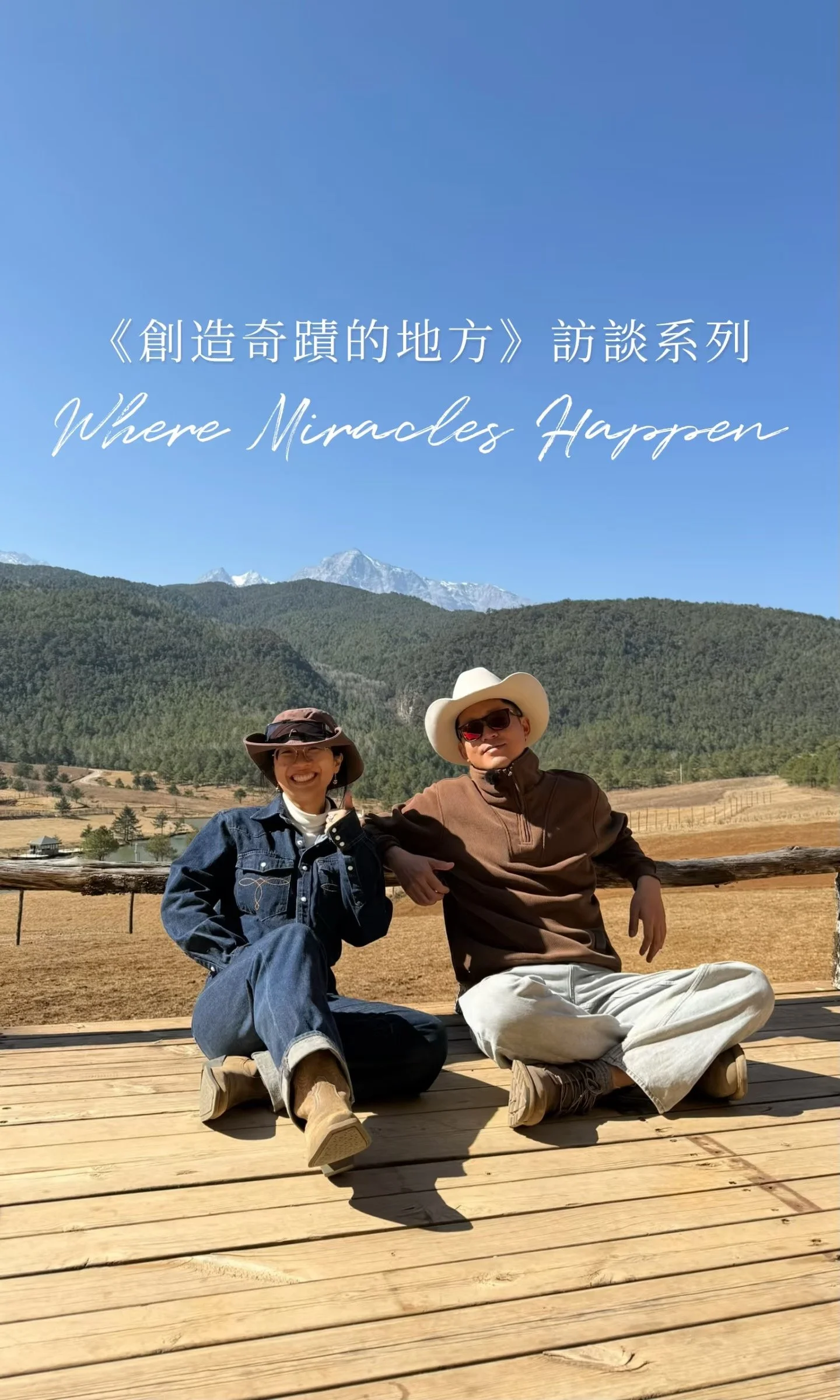
In this exclusive interview, Director Xing opens up about his life with horses, the philosophy of Miracle Ranch, and the miracles he has witnessed. Click the link below to watch.
Read Part Two: Where Miracles Happen: Inside the Ranch That Gives Horses Back Their Freedom
